Forest
FOREST RESTORATION
The mission of Forêt Hereford is first and foremost to restore its large private forest. The forest’s landscape has evolved from an ancient, complex, mixed-stand forest of noble tree species with a good quantity of dead wood (prior to 1850) to a much younger disturbed forest made up mostly of deciduous wood. The combination of beech, maple, spruce and hemlock (almost 80% of trees before 1850) has today given way to maple (mainly sugar maples), fir, and paper birch, which account for over 80% of the trees today.
On the other hand, climate change is already having significant impacts on ecosystems. Current and future changes will mean that certain forest species and communities will be less well adapted.
Forest management work in the coming years therefore aims to reduce the gaps between our actual forest and the future and probable natural forest, to increase the resilience of these forests. Also planned is the testing of various wide-scale approaches to enriching forest tree species that are much scarcer today (white pine, linden, hemlock, red oak, red spruce, etc.). It will furthermore be interesting to identify sectors with high forest productivity potential and to invest more efforts in them with a view to generating standing value.
Fact sheet on the evolution of the forest landscape in Hereford Community Forest
( .pdf file - French version only)
We also refer to numerous scientific publications in order to guide our choice of forestry interventions and species to favor in the context of this changing climate.
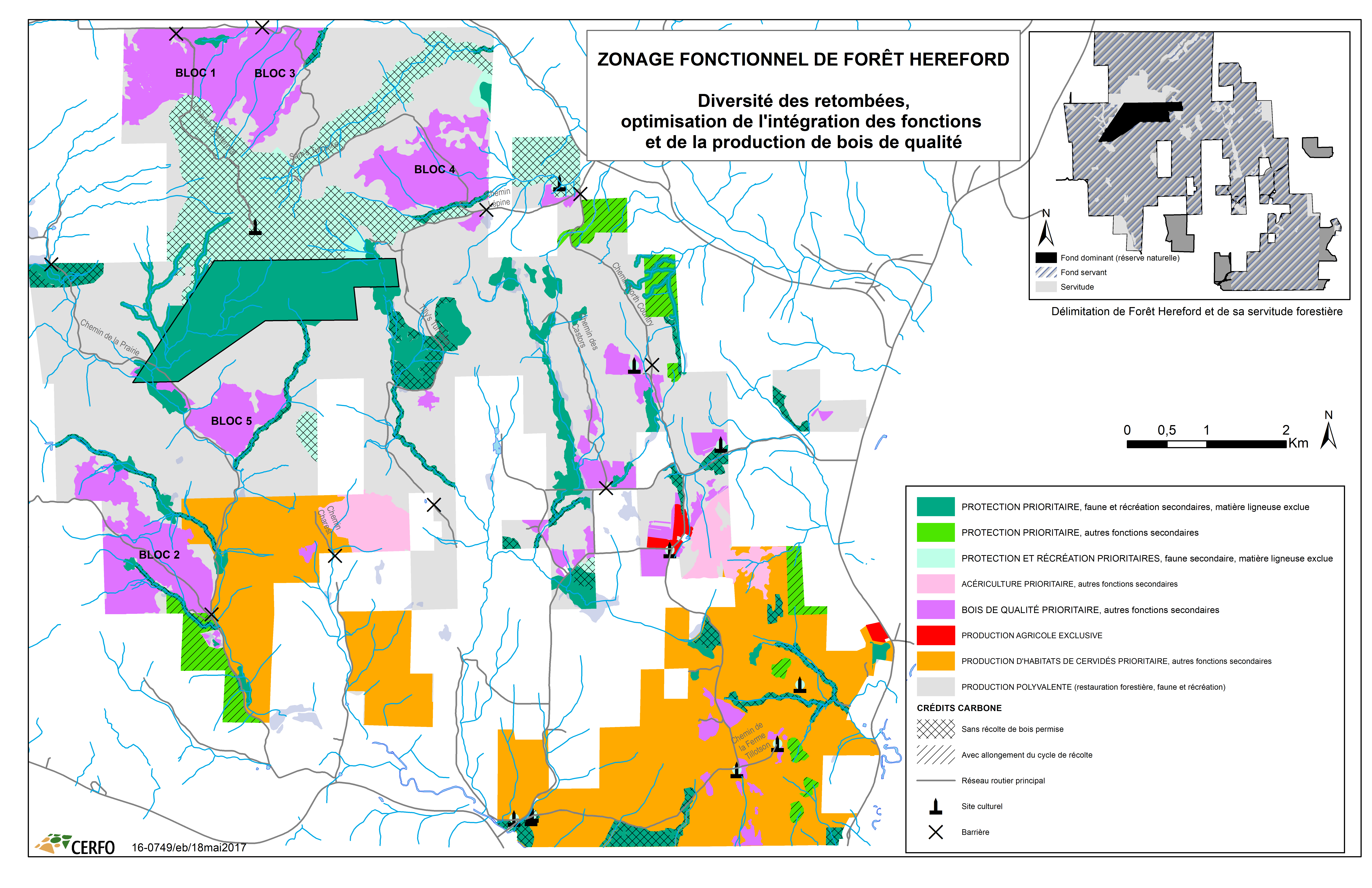
The functional zoning implemented in 2018 in the Hereford Forest also made it possible to modify land use planning approaches. Indeed, the development of the Pivot Forestry Project, by the social enterprise ECOTIERRA, now makes it possible to compensate forest owners for their change in forestry practices through income from VCS carbon credits. Thus, 10% of the Community Forest has been subject to a modification of forestry practices, and is now intended for passive managment to generate carbon credits. Also, in a 5% portion, standard harvest cycles are extended, making it possible to combine income from carbon credits and timber. These two new activities have an important contribution to the conservation of biodiversity and make it possible to diversify income.
 The realization of this charitable purpose of forest restoration is made possible in particular thanks to the contribution of local businesses. The Marcel Lauzon sawmill in East Hereford has been financially supporting Forêt Hereford since 2015. Also, in 2020, Champeau from St-Malo has committed to supporting the mission of Forêt Hereford over several years. These much appreciated contributions consolidate the necessary resources for the many innovative projects piloted each year by the Hereford Community Forest team.
SPINOFFS OF DEVELOPING THE FOREST
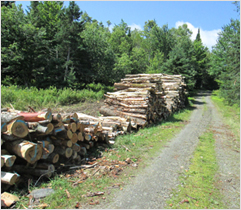
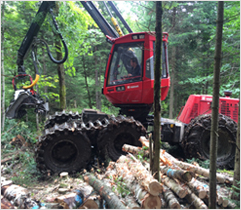
It goes without saying that these forestry efforts, although undertaken with the intent of restoring the forest for the benefit of the community, generate substantial economic activity. Harvesting 10,000 m³ (some 300 truckloads of wood) helps maintain more than 15 full-time jobs (in planning, technical expertise, harvesting, transportation, and processing) and produces direct spinoffs amounting to more than $600,000 annually.
Harvesting contracts are awarded by auction and mutual agreement. Since 2014, the organization responsible for forest harvesting operations and planning has been Groupement forestier des Cantons.
In September 2015, Forêt Hereford announced the acquisition of FSC (Forest Stewardship Council) certification when it joined the group certificate managed by the Syndicat des producteurs forestiers du Sud Québec (SPFSQ), in partnership with Aménagement forestier et agricole des Sommets and other regional forestry groups. FSC certification is the most widely recognized certification of its kind in the world. While acknowledging the many actions already undertaken by Forêt Hereford in the realms of conservation, community involvement, and compliance with laws and regulations, the certification will also require managers of the large community-managed private estate to adopt new ways of doing things.
For more information, consult the SPFSQ website:
www.spbestrie.qc.ca/la-certification-forestiere